REC! / Previous editions
European Creativity Biennial 2023
The second edition of the European Creativity Biennial, at the Shadok in Strasbourg, focusing on low-tech, digital intelligences and exploring society.
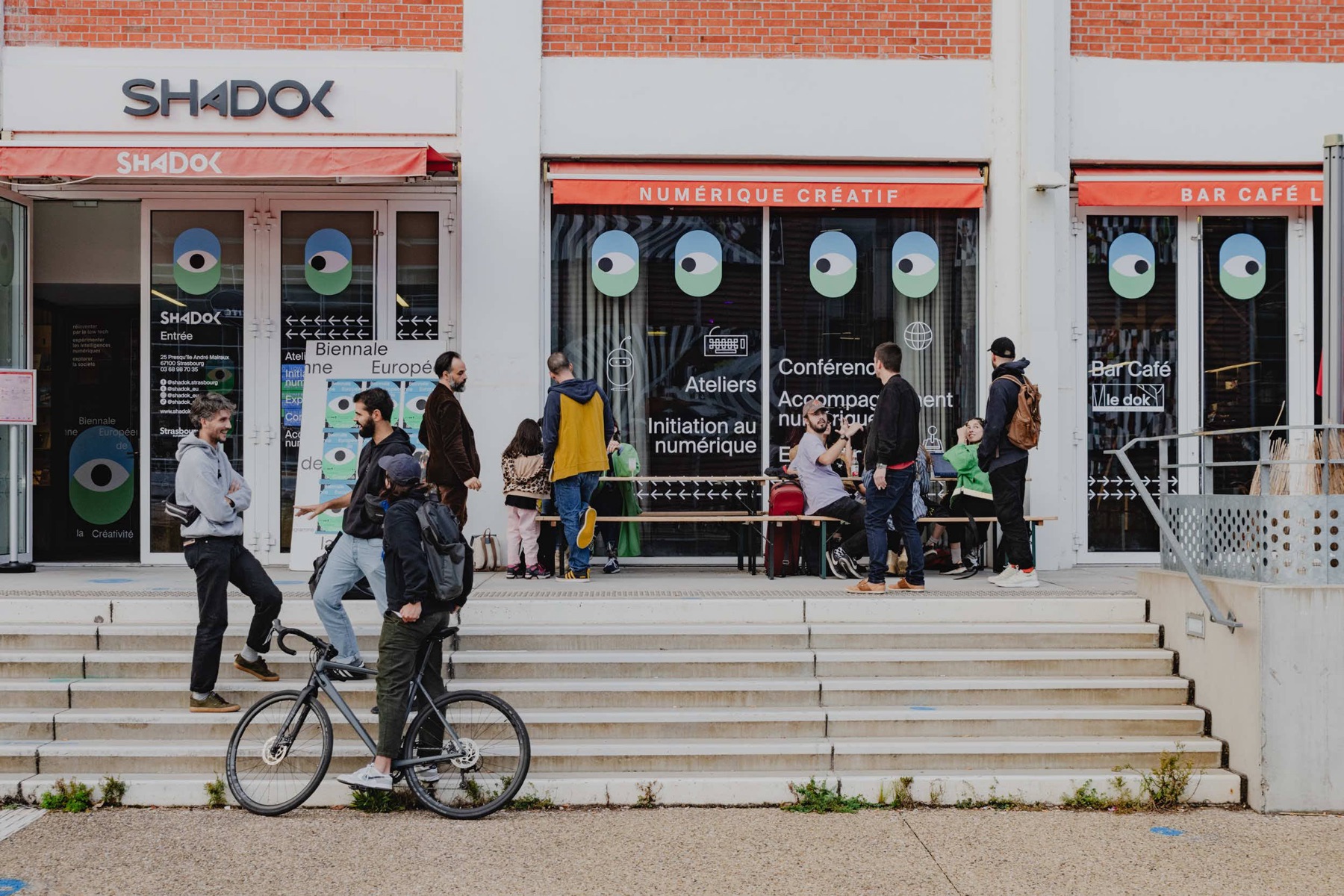
On 22 and 23 September 2023, the second European Creativity Biennial took place at the Shadok in Strasbourg. Two days, forty-six sessions, eighty-six speakers, more than six hundred visitors. An edition more compact in time and space, but extended to the other side of the Rhine.
View the poster (PDF) ↓ 2023 programme (PDF, in French) ↓
The ambition
The second edition kept the foundations laid in 2021 (showcase of solutions, space for reflection, laboratory for experimentation) and added a dimension the first had only sketched out: cross-border cooperation, which became a design principle rather than a stated intention. Anne Coreau, President of accro, summed up the aim: to bring together the region’s CCI players, introduce the general public to emerging projects, and encourage project leads to make their mark on the European stage. Pia Imbs, President of the Eurometropolis, recalled the link with the Pact for a Sustainable Local Economy.
A cross-border edition
Choosing a single venue, the Shadok, made it possible to focus resources on the Franco-German dimension. The programme was built with Spielfabrique, Kultur und Kreativwirtschaft Karlsruhe, LINK and arte; accro teamed up with the Kunstschule Offenburg. Workshops in two languages, simultaneous interpreting of round tables (headsets lent by the Eurodistrict Strasbourg-Ortenau), bilingual welcome and communication. Content accessible without a language barrier (video games, music, virtual reality) reflected the same commitment to a mixed audience. A wider catchment area: the Eurometropolis, Karlsruhe, Offenburg and the Eurodistrict, Alsace.
The three themes
Low-tech and reinvention
Technical sufficiency and reuse: the prison design exhibition “On fait avec ce qu’on a” (We make do with what we have) by Tristan-Moana Engel, the “Chaud Time” installation (Black Leaf, ATTA02, Ben Jack Nash), a screening of the documentary Low Tech, les bâtisseurs du monde d’après, workshops (tufting, upcycling, embroidery, crochet, radios turned into Bluetooth speakers).
Digital intelligences
L’Ososphère’s VR Artothèque (supported by Tango&Scan, with the Strasbourg European Fantastic Film Festival), the Longevity Music School Playground, two alternative games by Random Bazar (RotoRing and SUPER), the immersive expedition “Éternelle Notre-Dame” and Orange’s “Digital magicians” workshop, and a headphone walk by the musician Nebbiu.
Exploring society
Care, inclusion and the place of creation in public policy: the HUS Maison de l’éducation thérapeutique (La Fabrique de l’hospitalité, Ateliers RTT), a talk on Care Design by Abigaël Willard, “Appartement-témoins” by Lucile Rimbert, the Marcel digital assistant by Familles Solidaires, and Art Thinking presented by Nil Samar. Three cross-cutting trails (design, music, audiovisual) and a professional trail punctuated by networking.
Highlights
- Challenge your project: a tailor-made jury (Orange, EM Strasbourg, Pépite Etena) before which project leads put their ideas to the test.
- L’Industrie Magnifique: a round table with Jean Hansmaennel on art and industry in public space.
- Cross-border cooperation in culture: with the European Collectivity of Alsace and Karlsruhe.
- Modema: a sound and visual performance by François Delamarre (glass, light, modular synthesiser), followed by a discussion with the CIAV Meisenthal and L’Ososphère.
- The Creative Swap and the concerts (Nebbiu, Las Baklavas).
Results
46 sessions (14 workshops, 10 keynotes, 9 experiments, 6 round tables, 4 concerts, 3 exhibitions), 86 speakers, more than 600 visitors over two days. Participatory formats and interactive experiments worked better than talks, which shaped thinking about what came next. Communication via the dedicated website la-biennale.eu, 1,000 printed programmes, 100 A3 posters and 80 digital street furniture displays.
Funding & partners
Funding: the French State (Grand Est Prefecture), the Grand Est Region. Partners: City and Eurometropolis of Strasbourg, Eurodistrict Strasbourg-Ortenau, arte, Fabéon, L’Industrie Magnifique, University of Strasbourg, Longevity Music School, Hochschule Offenburg, Kunstschule Offenburg, Orange, Kultur- und Kreativwirtschaft Karlsruhe, IDeE, LISAA, Offenburg Games, Les Ensembles 2.2, Strasbourg European Fantastic Film Festival, ADEUS. Direction: Sophie Madjibé. Graphic design: ramel·luzoir. Photo credits: Bartosch Salmanski and Yannick Calvez.