In their footsteps: Farid Maniani
Read our interview with Farid Maniani about his project Tech4Gaïa: bee monitoring for the common good and the ecosystem.
20 April 2023
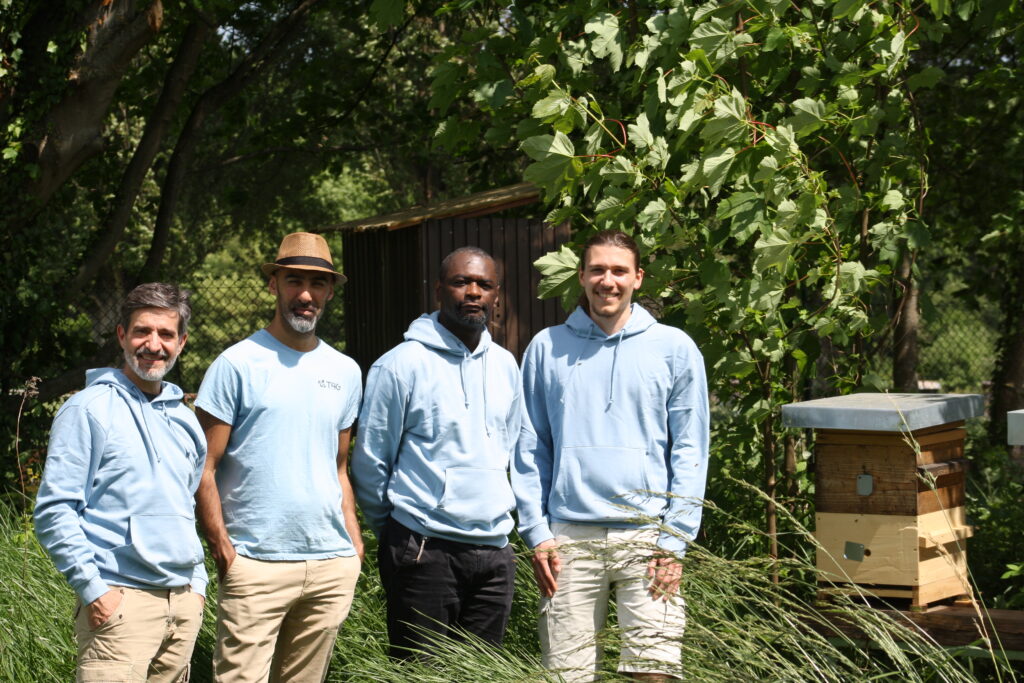
Introduce yourself and your project:
My name is Farid, I am the President and co-founder of Tech4gaïa. Several of us embarked on this adventure five years ago now, and we officially set up the company in October 2020. Since then I have left my teaching post to devote myself fully to this wonderful adventure. Our first Tango & Scan was in 2018. I am also an amateur beekeeper with an interest in all things digital; in fact I am president of the Manipulse fablab, which initiated our first Tango & Scan in 2018, without which I would not be here today. When we launched the project, the initial idea was: how can we get people interested in, and aware of, the protection of pollinators and biodiversity? We focused mainly on bees, which led to the creation of an association, Uni-Vers-Abeille, in 2018. We decided to put digital technology at the service of biodiversity: we monitor bee colonies, which are our main focus today.
The project uses sensors to monitor bees and obtain simple but relevant indicators, such as colony growth, the hive’s vital data (temperature, humidity, etc.), as well as open data that help us understand the ecosystem in which the colonies live. This monitoring is used by a range of players, such as beekeepers, industrial sites and companies with hives on their premises. It is also useful for research, as in the case of a study of black bee colonies carried out in the Ardennes. Thanks to this versatile tool, different public and private players can meet their specific needs.
When you were a child, what did you dream of becoming?
A maths teacher. I loved maths, I loved numbers. In the end, I worked in retail, which I left to become a primary school teacher, and I quickly switched to special education in secondary schools with pupils with special educational needs. The funny thing is that I started teaching, and loved teaching, subjects I did not like as a young person, such as history or French.
What is the craziest or most unconventional idea you have put into practice in your project?
What surprised people was the idea that we want to bring everyone together around a single issue: protecting biodiversity. In reality, public and private players are constantly attacking each other: amateur beekeepers attack the professionals and vice versa; people attack local authorities because they never help enough; people attack researchers because they sometimes produce studies that feel biased, as when tobacco was presented as “good for your health”; people attack farming for its impact, and industry too. We never agree, yet in absolute terms we all have our share of responsibility.
The idea of getting everyone around the table and recognising that we share responsibility for solving the problem is not easy to achieve when it comes to “change management”.
And did it work?
It works, but over varying timescales. With local authorities, for example, it takes longer. Our subject cuts across many fields. It sounds basic when I talk to you about bees, but in fact when we talk about bees we are talking about biodiversity, about food, about digital technology because we are talking about data, and about land-use planning. The paradox is that there is a climate emergency, and yet when all the players are gathered around the table, none of them commits straight away. They say “I’m waiting for someone else to commit with you”, so we have been talking with some of them for more than a year without making progress. I feel we are not moving fast enough.
Your beginner’s mistake?
I will be a little harsh, but it was assuming that with young people (and I really do trust the younger generations) we would be able to move forward quickly enough. This is not to criticise them, far from it. What I am really talking about are recruitment mistakes. We should have focused on finding profiles with a certain level of expertise, which is a real plus when developing a project in its early days. Another mistake was believing we would carry out our roadmap exactly as written, give or take a few weeks. A kind of overconfidence.
The achievement you are proudest of?
We have received some wonderful recognition, which to me is remarkable because I keep saying that we are still a young start-up. We received two national awards from an organisation called BearingPoint for connected objects and data. And in December we received a social and solidarity economy award from La Fabrique Abeille Assurance: out of 400 applications, we were among the 15 winners, so we are very proud of this recognition.
One piece of advice for those who want to get started?
Surround yourself with people who are better than you. I consider that everyone around me is remarkable and much better than me on a whole range of subjects.
Transcribed from the spoken interview.