In their footsteps: Harmonie Begon
An interview with one of our former award winners about her new project
20 April 2023
Introduce yourself and your project:
My name is Harmonie Begon. After five years at the HEAR, I became a designer. Very early in my studies I specialised in craft production and heritage. Why did I choose this specialisation? Because I see craftsmanship as a choice of society; I specialise in it for the ecological, social and moral values carried by this way of producing objects. I started to think, “actually, craft is not just the old man in the village”; it can also be people who have a good time through craft practices. I then became interested in work integration schemes, where the work asked of people is often not very rewarding, such as sorting waste or carrying heavy loads… These are not occupations that give you confidence in your skills. My first idea was to offer other, more rewarding possibilities, and that is how I decided to focus on upcycling Emmaüs’s ceramic waste. My project combines two ideas: on the one hand, upcycling ceramic waste at Emmaüs Mundo, and on the other, asking how to upcycle it. And I answered that by killing two birds with one stone: by giving value to the people within the organisation.
When you were a child, what did you dream of becoming?
This question reminds me of the ENSCI entrance exam. I sat it twice and was asked the same question both times: if you had an unlimited budget, what project would you do? And each time I answered “a restaurant”, which I suppose partly explains why I wasn’t accepted! When I was little I wanted to be a singer. But later I know I had passions: I loved DIY, I tried everything to do with creative hobbies. I knew I liked it, but I didn’t know the jobs or the words to describe these passions. The question that remained was “but what are the jobs?”, and today, after five years of study, coming out of an art school, the question is still the same. There is a certain vagueness; I find it hard to define my profession. The word designer covers a lot of things, so I use it, but it doesn’t match my practice 100%, which is why I combine it with my specialisations: I am a designer specialising in craftsmanship and heritage.
What is the craziest or most unconventional idea you have put into practice in your project?
The project itself, because it was born from simple conversations with two people: we met six or seven times and the project took shape. It came from an idea that itself stemmed from an assignment: imagine your ideal clients, and I don’t particularly enjoy that kind of exercise. Then one of my fellow trainees said to me, “don’t see it as part of a business model, see it as if you were being asked who you dream of working with”, and that is when I thought that Emmaüs would be the perfect partner. Why? Because it is a model that can claim to compete with large retailers. On the other hand, once your project exists, the reality on the ground tempers your desire to do other crazy things; you are already trying to keep your ship on course.
And did it work?
Yes and no. Yes, because I work at Emmaüs, I have my office here (only for the past two weeks, but before that I worked all over the association), and everyone knows why I am here. All these exchanges cannot be quantified on paper, but they are central to a project’s success. It is a project that takes a lot of time; people are central and part of the process. You have to be able to bring people along all the time; if just one person holds back, it holds back the whole project. Some successes are simply found in moments of exchange that unblock situations. All these factors allow us to say that integrating design into Emmaüs is possible, perhaps not today, perhaps not tomorrow, because other spaces dedicated to it will probably need to be imagined, but in any case the model is possible. To sum up: yes, it worked, because the model is possible, but no, because it may not be possible here and now.
Your beginner’s mistake?
Clearly, being naive. Thinking that everything would go as I had dreamed or imagined. I thought we would really create a workshop in one go, with plastic boxes to store everything neatly on nice shelves. But also, and above all, I really thought we would save all the crockery that gets thrown away. Even if the workshop were set up perfectly, it would still only be a fairly small percentage of crockery “saved”. It is a detail, but it helps raise people’s awareness of the amount of waste; the aim is not only to produce objects, there is also a human purpose behind it.
The achievement you are proudest of?
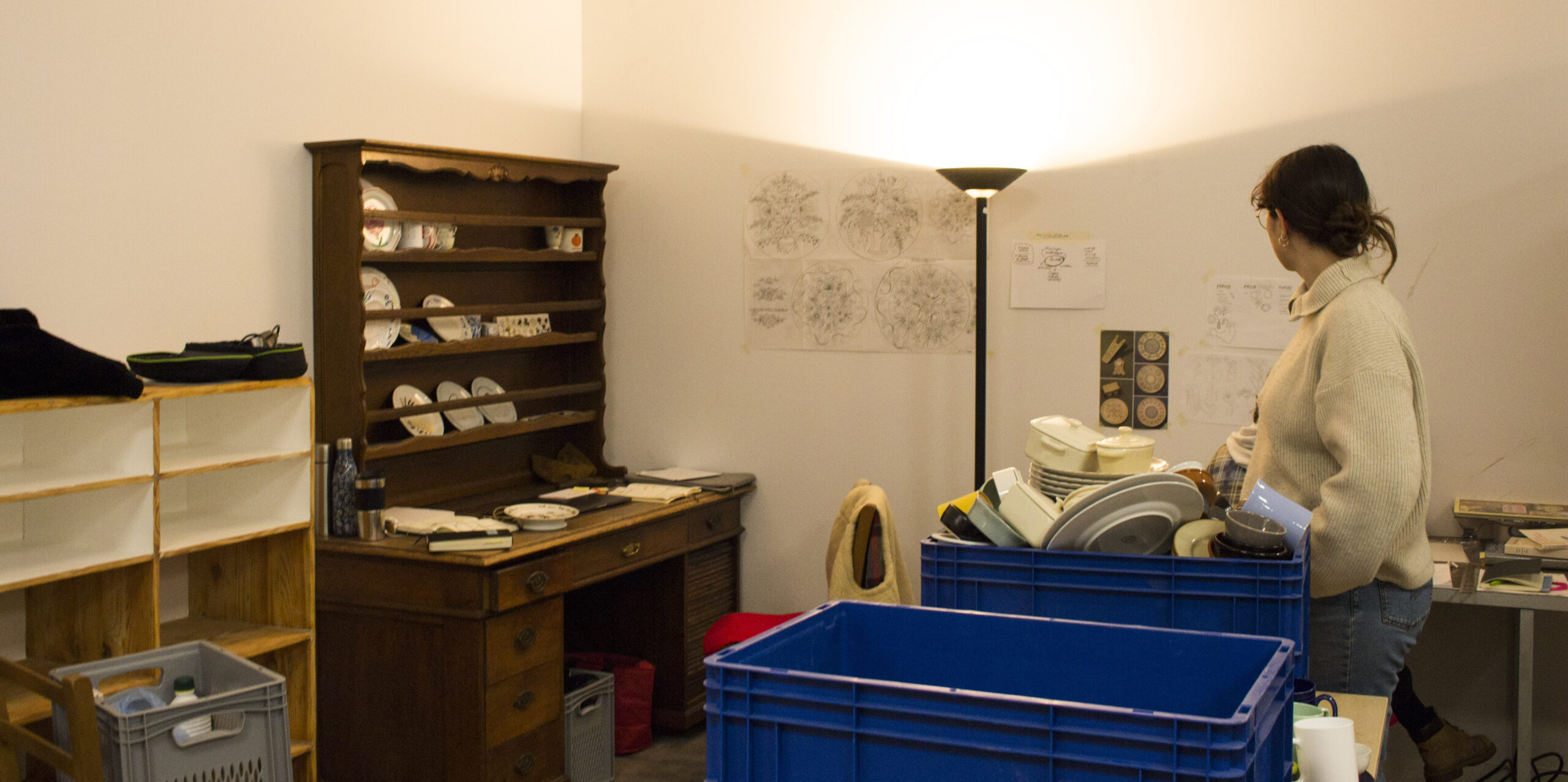
Managing to get an office. Nobody will really be able to grasp what it took to get it. Getting this space took six months of work, presentations and discussions, so this space is a success.
One piece of advice for those who want to get started?
Simply go for it, and start. My second piece of advice would be to take stock fairly often. I do this at the end of a project, a kind of review where I think about what I liked or didn’t. It helped me understand that everything can be transformed and that it is up to you to make it work. You need to get started while keeping in mind that the project will probably change along the way to adapt to the reality on the ground. You have to keep an open mind.
Transcribed from the spoken interview.