Meet Anne Coreau and Thierry Ianni, president and vice-president of accro
The president and vice-president of accro look back on their roles, the challenges facing the association and its long-term vision.
21 June 2024
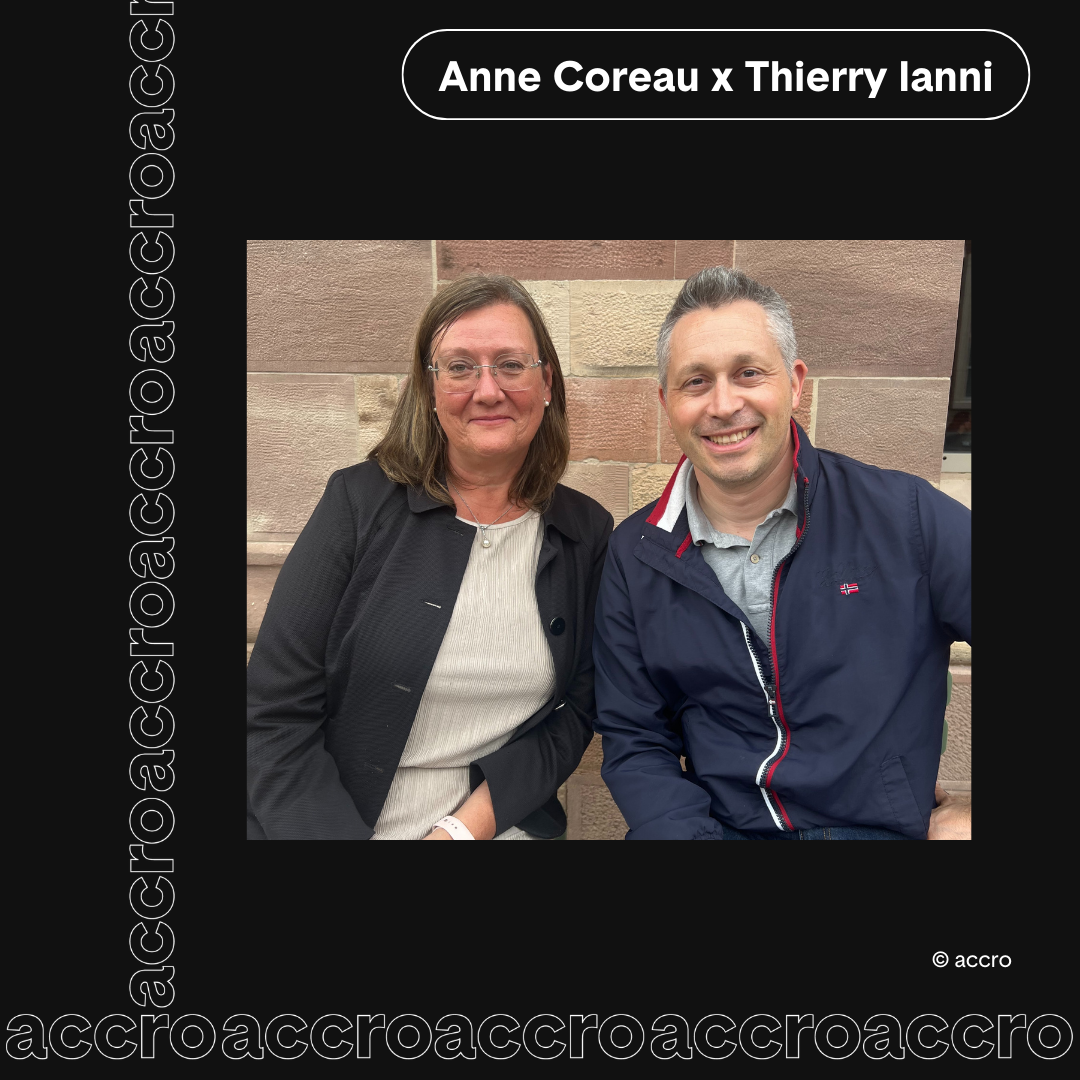
Introduce yourselves
My name is Anne Coreau and I currently work at Orange as Director of Innovative Projects in Alsace and Lorraine. The role essentially consists of facilitating local ecosystems and rolling out Orange’s innovation programmes, for example supporting start-ups or developing uses for a technology such as 5G.
I previously worked in sales and in technical and commercial liaison in Germany. Today I work in ecosystem facilitation.
My name is Thierry Ianni, and I am industrial director at VHM, a very dynamic, century-old, multi-activity Alsatian company. As vice-president, I complement everyone’s experience with my professional network. I also bring the perspective of the industrial client when a CCI business approaches one.
What does the role of president/vice-president involve?
Anne: I see two very important aspects. The president is responsible for the general management of the association: strategic decisions, monitoring objectives, and working with the director, who will be joining us shortly. We had started this joint work between management and the presidency with Sophie and Thierry. There is also a relationship that seems just as important to me and is not given enough attention today: the relationship with the members of the board, which can be very enriching for the association. My second function as president is representation. I am the spokesperson for accro with partners, sponsors, institutions and the general public. Our representation work with Thierry is complementary and allows us to compare our views on accro’s image and on the decisions for the association.
Thierry: As vice-president, I mainly provide logistical support to the association and to the president. I am also a sounding board on certain subjects. Communication between us is always good, which allows us to work together in excellent conditions. Not every association has a vice-president, so working as a pair is both an opportunity and a strength. All the more so because this is the first time accro has had a vice-president.
What are the main challenges you face in your respective roles?
Anne: As president, my main challenge is to position accro within the local ecosystem as a partner to the many organisations that work, closely or more distantly, in the CCI field. I think the cultural and creative industries are still very often seen through an “artist” image. And yet the word industry clearly shows the direction in which the field is moving. Talking with Tango&Scan winners and members, I realised that the business development side, which is becoming very important today, was very rarely emphasised. I want to develop this aspect further for our members. The CCIs are also an economic sector that must work with every sector in the region: industrial companies, incubators, cultural agencies and designers. It is essential to find the connections and synergies between all these fields so that everyone benefits.
Thierry: On a personal level, the challenge was discovering the voluntary sector and the world of the CCIs, both of which were new to me. The other challenge is certainly to bounce back positively after the departure of Sophie Madjibé, who did a remarkable job, in order to secure and increase accro’s reach.
What motivated you to join and get involved in the association?
Anne: Having been active in the local ecosystem, particularly the digital one, for more than ten years, I wanted to get more involved in the region and satisfy my curiosity about the world of the CCIs.
Thierry: For my part, I had the chance to take part in the European Creativity Biennial in 2021 as a speaker in a round table, which introduced me to the association and also to the world of creatives, in this case industrial designers. When the opportunity to support the association as vice-president came up, I accepted straight away.
How do you see accro’s impact on the cultural and creative industries in Strasbourg?
Anne: I really think there is one key element that cannot be overlooked: the Tango&Scan call for innovative projects, which accro has managed for 13 years now. Tango&Scan has had a significant impact on the region, because the aim of bringing CCI businesses together with digital companies is a unique opportunity. It shows the synergy that is possible between the two worlds and the different players. I sincerely think we should keep developing it and take the approach further by adding experimentation components to strengthen its impact.
Thierry: accro has not yet developed its full potential; it is a well-known association with deep roots in Strasbourg. Its impact is growing, and the new management will know how to build on that.
Which of the association’s successes are you particularly proud of?
Anne: When Sophie Madjibé left recently, we launched a recruitment process to find her successor, and the diversity of the candidates’ backgrounds and professional experience showed how far accro’s reputation reaches.
Thierry: Above all, I am proud of the teams. They are young women who have already shown their full ability to manage large-scale projects that demand strong personal commitment. Once again, I take my hat off to them.
What is your long-term vision for accro?
Anne: I think it is important to keep working on synergies with the various players in the ecosystem. As part of the Tango&Scan call for projects run by the Eurometropolis of Strasbourg, it seems important to me to keep encouraging project leads in order to build a real talent pool, develop experiments and strengthen the association’s reach. As for collective intelligence within the association, I think this is an aspect that will need strengthening with the arrival of the new management. It is important to work with both the teams and the board.
Thierry: I imagine more diversified funding and more comprehensive service offers.
How do you see the cultural and creative industries evolving in Strasbourg or the Upper Rhine, and how will accro adapt?
Anne: From a European perspective, cross-border interactions have already been set up by members of the team. And the future is still to be written.
Thierry: We will have to cope with a sharper fall in public subsidies, and therefore come up with strong proposals to meet that challenge. accro will need to keep its flexibility and its ability to read its environment in order to adapt.
What strategic collaborations or partnerships do you envisage to strengthen the association?
Anne: We are lucky to be in a cross-border area, so we need to find new strategic partners across the Rhine. This next step will be interesting, because this geographical proximity sets us apart.
Thierry: We will define this with the new management, which should be in place by September at the latest. It will be an opportunity to redefine our priorities and set a clear timetable for scaling up across the different themes.