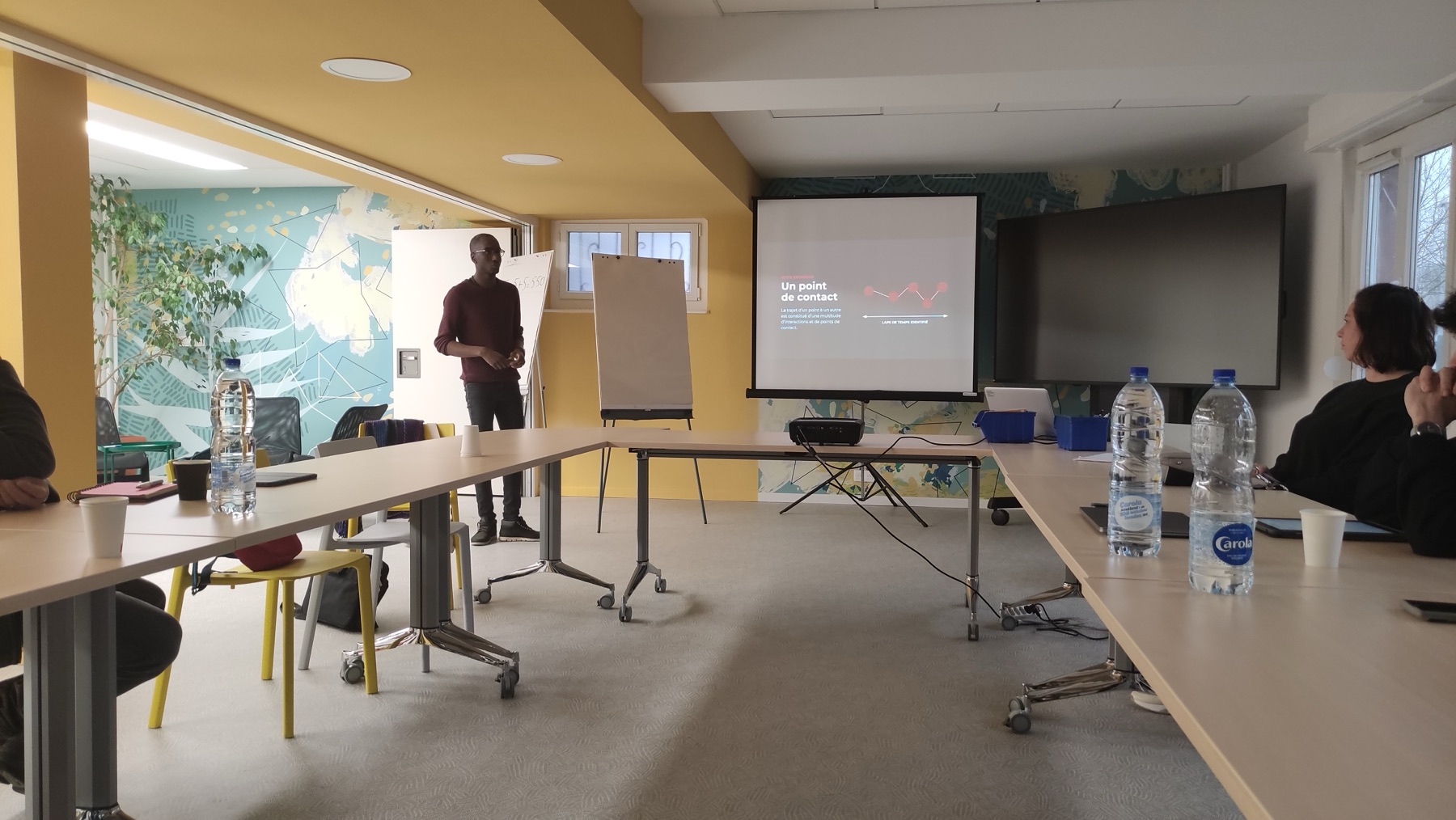
A pitch means telling the story of your project in a limited time, to someone who does not know it and who has to decide something at the end: to fund, to select, to partner. We are going to build it as we would in a workshop: a structure that holds up, pointers for speaking, and what you need to stand firm when the panel asks questions. On your feet, and rehearse out loud: that is how you improve.
A pitch is not a summary
The number one misconception, and the first one we correct in every workshop: thinking that a pitch means telling the project on fast-forward, squeezing into two minutes everything you would say in ten. Guaranteed result: you speak too fast, your listeners drift off, and the panel mostly remembers your nerves rather than your project.
A good pitch does not tell everything. It makes choices. It gives just enough information for the listener to understand the project, see why it matters and want to know more. The rest can wait for the questions: keep some material up your sleeve.
The six-part structure
Here is the outline we use in our workshops. It works for most CCI project pitches: calls for projects, selection panels, presentations to a partner. Learn it by heart, it will serve you throughout your life as a project lead.
- The hookA sentence that grabs attention from the very first second: a figure, a concrete situation, a question. Above all, not a project title read out flatly.
- The problem or needWhat is not working today, or what is missing, for the target audience. The panel needs to understand why the project is necessary even before what it offers.
- The solutionWhat your project actually brings in response to that problem. This is the heart of the pitch and deserves the most time, but never more than half.
- The proofWhat shows that it works or can work: a tested prototype, early feedback from users, a comparable experience, skills already demonstrated.
- The model and the teamHow the project is funded, who is leading it, and with what skills. A panel wants to know who it is relying on, not just which idea it is backing.
- The askExactly what you are looking for: a grant of a given amount, introductions, a partnership, an opinion. Never end on something vague.
Adapting to the time available
- 30 seconds: the elevator pitchA hook, the problem in one sentence, the solution in one sentence, the ask. No detail, just enough to make someone want a meeting. Practise saying it while walking: it is the most useful format day to day.
- 2 to 3 minutes: the most common panel formatThe six parts of the structure, each in two or three sentences. This is the format of Tango&Scan pitches and of most call-for-projects panels.
- 5 to 10 minutes, with slidesThe six parts developed, one or two slides per part. The format for a presentation to a partner who has set aside dedicated time. The rule does not change: a slide carries one idea, not ten.
The right reflex
Prepare the short version first. A long version is built by adding detail to a structure that already holds up in thirty seconds. The reverse never works: cutting a ten-minute presentation at the last moment produces a disjointed text.
Speaking: what matters as much as the words
Content alone is far from enough to make a pitch convincing. Three things count as much as the words you choose.
- PaceSpeak a little more slowly than usual and pause after each strong idea. Nerves push you to speed up, which has exactly the opposite effect to the one you want. Breathe.
- Eye contactAddress the whole panel, not just the one person who seems most important or most friendly. Look around the room regularly: everyone should feel included.
- Tangible proofShow an object, an image, an extract, rather than describing everything out loud. In the CCIs, the work often already exists in a form people can see or hear: you might as well use it rather than leaving it in your bag.
Rehearse out loud, on your own and then in front of someone: it makes all the difference. A text that seems clear on paper often turns out to have sentences that are too long once spoken. Time every rehearsal, so you avoid the nasty surprise of being cut off halfway through when time runs out.
Preparing for questions
A pitch rarely ends without questions, and that is often where the panel’s decision is really made. Three types of question come up almost every time:
- The business model: how the project intends to keep going once the funding requested has run out.
- The timeline: when each stage will be reached.
- The project lead: why you or your team are best placed to carry out this project.
Prepare short answers to these three types of question before your slot, so you are not improvising from scratch. Never hesitate to say “I don’t know yet, here is how I plan to find out” rather than inventing an answer on the spot: an experienced panel very quickly spots an answer made up in the moment. Honesty scores more points than bluffing.
The mistakes that come up most often
- Starting with a long introduction about yourselfThe panel has usually already read the application; it is waiting for the project, not a three-minute spoken CV.
- Reading from a scriptIt shows and it can be heard: your voice loses all its inflection. Work from memorised key points, not a full text learnt by heart.
- Overloading the slidesA slide full of text draws attention away from what you are saying. Slides illustrate; they never replace speech.
- Not anticipating obvious objectionsIf your project has a known weakness, raise it yourself along with a possible answer, rather than waiting for a panel member to point it out first. Take the initiative.
- Running over timeConsistently overrunning signals a lack of preparation, and often cuts the presentation short before the final ask, the most important part of the whole pitch.
What comes next
Once your pitch is built and rehearsed, it usually accompanies a fuller written application, the one you submit for the call itself.
The group workshops run by accro include pitch rehearsals with immediate feedback. It is often the best way to spot what does not come across when a text is simply read; come and try yours out in front of a real audience.