In their footsteps: Anatole Boule
Discover in this interview the world of Anatole Boule, the visionary mind behind Atelier Pandore.
25 October 2023
Introduce yourself and your project:
My name is Anatole, I turn 33 this year, and I am an archaeologist specialising in architecture. Since finishing my studies, I have specialised in popularising knowledge and in cultural mediation. During my studies, and from the age of 16, I worked as a youth leader in holiday camps, then from 2019 I became a trainer of youth workers in the field of popular education. This sector carries strongly social values, based on the idea that all citizens should be able to express political views whatever their initial level of education. Various tools and methods are used to put popular education into practice; the best known is youth and community work, a sector overseen by the junior ministry for popular education, attached to the Ministry of Education and Sport.
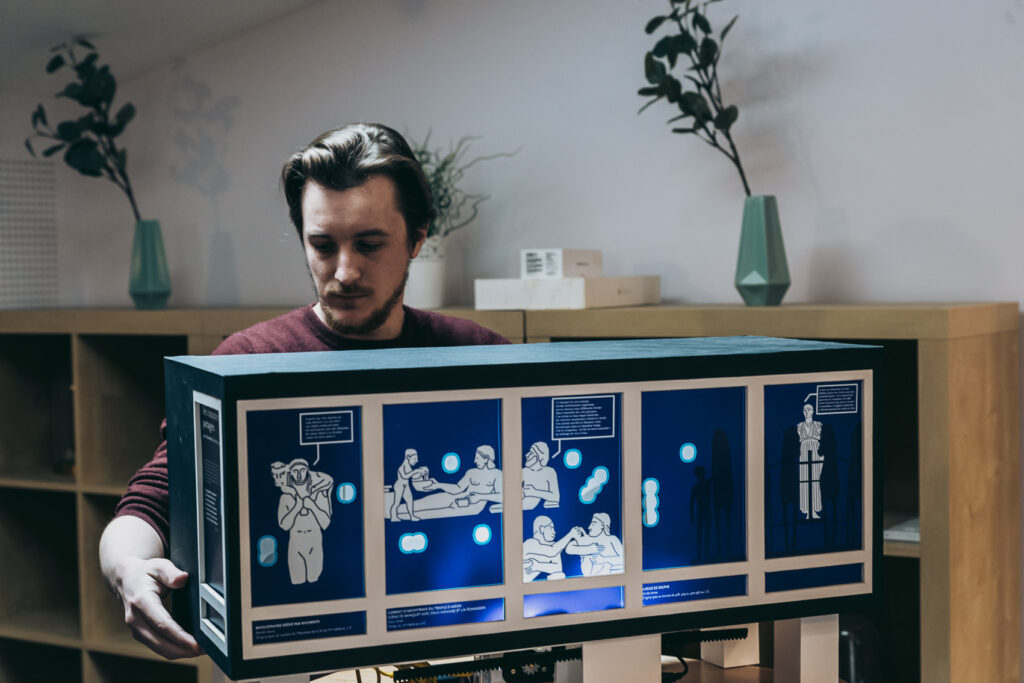
Atelier Pandore, which I founded in 2018, is the fusion of academic research and archaeology, what I call “cold knowledge”, with all the knowledge from youth work and popular education, which I call “warm knowledge”. The whole approach of Atelier Pandore is to create mediation tools aimed at working-class audiences. Everything starts with the audience.
When you were a child, what did you dream of becoming?
When I was little, from the age of 10, I wanted to be an archaeologist. The short version is that I was something of a dunce at secondary school, and after failing my baccalaureate twice, I left school without it. That is when I started doing youth work seriously, and I very quickly realised that without the baccalaureate it was going to be hard to go further. I eventually passed it as an independent candidate, but unfortunately, without a proper academic record you cannot get into the grandes écoles. I turned to university, which was an open door, and luckily in France we have that opportunity. Then, when the question arose of what to study at university, I thought back to my childhood dream of archaeology.
What is the craziest or most unconventional idea you have put into practice in your project?
Pandora’s box started with my time at a university museum called the Adolf Michaelis museum, which I had the chance to help relaunch, a very rewarding experience. The museum talks about Zeus and Athena, about all the stories from Greek or Roman mythology that you have heard somewhere before. We could not understand why its visitors were only academics or students. Of course, the museum is inside a university, so it is logical to meet those audiences, but another reason was that it was not seen as a place open to everyone. And despite all our efforts, it was very hard to attract outside visitors. When I finished my studies I asked myself, “how can we make these collections visible?”, and my answer was “I’ll put them in the street”. The basic idea of Atelier Pandore is to put works of art in the street.
And did it work?
Yes and no. The concept makes it possible to put the idea on the table and say: from now on, we can consider placing works in public space. The fact is that, psychologically, it is still a problem to do so, because it means exposing works to risk for the sake of mediation. But that has been the whole job since 2018: trying to convince people, showing that it exists and that it is feasible. Above all, there is a global movement to open up collections; in particular, a report on 21st-century museums, based on a study carried out in 2016, highlights it. A museum must open up, speak to new audiences and go beyond its walls, and this is a policy direction of the Ministry of Culture.
Your beginner’s mistake?
Which one to choose? It is complicated, because you have to go through these things to move forward. The lesson I draw from it today (though in five years I might tell you it was not a mistake) is that if I had to do it again, I would take more of a marketing approach. Pandora’s box is an ideological product, a crazy concept: putting works in the street in the most radical way possible. I can prove that it performs, because we now have humidity and temperature readings. If I had to do it again, I would make a product that costs much less, that is better funded from the start, that involves less risk and that is more flexible in terms of performance inside. A second point, common to all project builders, is having a clear vision. At the beginning I had not clearly expressed Atelier Pandore’s point of view. Today I can tell you: I want to address working-class audiences. Back then it was vaguer, more like “I put works in the street”, whereas the real stance is to ensure that working-class people have access to cultural and heritage works.
The achievement you are proudest of?
No idea, perhaps the next exhibition.
One piece of advice for those who want to get started?
In the series “Où vois tu Pandore” (Where do you see Pandora) on our Instagram, we give four main pieces of advice. I think the most relevant is when I quote the TAVU project, which says “we work with who we are”: if you take the trouble to build a project in the cultural field, you know you will not get rich. So if you go for it, you need to see your idea through to the end, and what you want to say. That does not mean being deaf to what the market tells you, that is not what I am saying, but in the end your project has to match the story you want to tell.
Transcribed from the spoken interview.