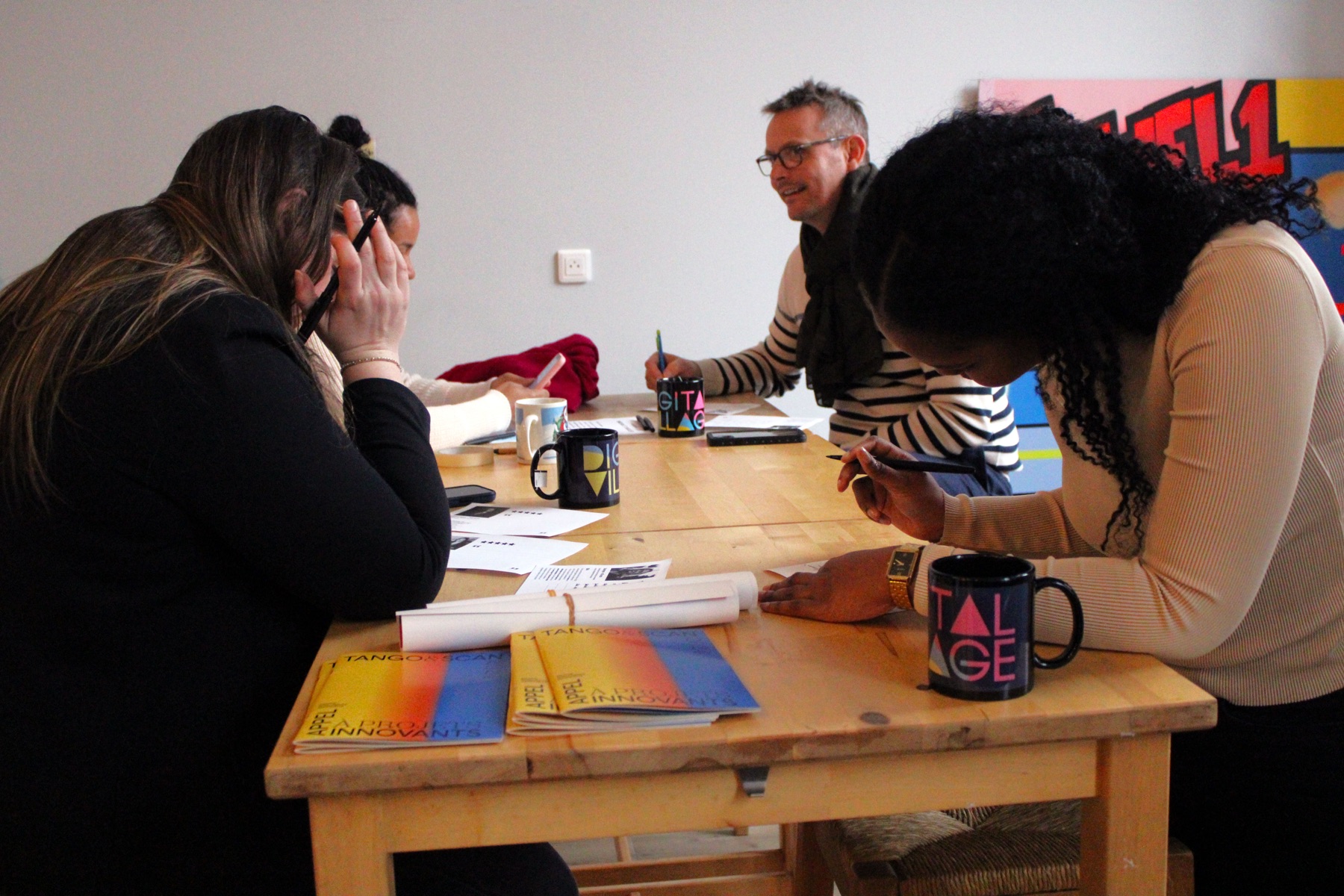
Nine boxes, one page, a pencil. That is all you need for this module. The Business Model Canvas forces you to answer every question a business model raises, in order, without skipping a single one. We are going to fill it in with a concrete example from the cultural and creative industries, and you will come away with the method to do the same for your own project.
What it is for
The tool was developed by Alexander Osterwalder in the mid-2000s and has proved its worth everywhere, from tech start-ups to ceramics studios. Its strength is its format: nine boxes on a single sheet, filled in with a pencil, that you can correct in five minutes. No need to reopen twenty pages of Word to test a new hypothesis: you rub out a box and start again.
It does not replace the financial forecast, remember that. It comes first, to lay out the logic of the project before you get the calculator out. A canvas takes an hour or two to fill in, alone or in a small group. It is often the very first exercise we do together in a support session at accro.
The nine blocks, one by one
The canvas reads from left to right, with the value proposition in the middle, at the heart of the engine.
Who provides a resource or an activity you do not handle on your own.
What you actually need to do to create the value.
Skills, equipment, team, venue, brand, network.
What the project brings, from the customer’s point of view.
The type of relationship: tailored, community, self-service.
How you reach, sell, deliver and follow up.
Who buys, who uses, who decides.
Fixed costs and variable costs.
What each segment brings in, and how it pays.
- 1. Customer segmentsWho buys, who uses, who decides. They are not always the same people. A project lead often has several segments: the general public, institutions, other professionals. List them separately, otherwise you risk offering them all the same thing at the same price, and that never works.
- 2. Value propositionWhat the project brings to each segment, and why that person would choose you over an alternative, or over nothing at all. A good proposition is phrased from the customer’s point of view: forget “I make beautiful illustrations”, think “your brand gains a recognisable visual identity in three weeks”.
- 3. ChannelsHow you reach each segment, sell, deliver and provide after-sales service. Social media, fairs, word of mouth, a platform, a distribution network. A channel that works brilliantly for one segment may do nothing for another: test them separately.
- 4. Customer relationshipsThe type of relationship with each segment: personal support, community, self-service, automated subscription. This box has a hidden cost: a highly personalised relationship takes time and limits how many customers you can look after at once.
- 5. Revenue streamsWhat each segment brings in, and how it pays: one-off purchase, subscription, commission, licence. This is where you bring in the revenue streams set out in the business model guide.
- 6. Key resourcesWhat is essential to deliver your proposition: skills, equipment, team, venue, brand, network. In the CCIs, it is very often a rare individual skill. The awkward question: if you stopped tomorrow, would that skill leave with you?
- 7. Key activitiesWhat actually needs doing: creating, producing, distributing, maintaining a platform, prospecting. Some activities eat up time without paying off straight away, prospecting above all, and yet they are essential. Write them down anyway.
- 8. Key partnersWho provides a resource or an activity you do not want to, or cannot, handle on your own: supplier, venue, co-producer, support organisation. Put these partnerships down on paper, otherwise you find out too late that they depended on a single personal contact.
- 9. Cost structureWhat the resources and activities above cost. Keep fixed costs, which fall due whether or not you produce anything, clearly separate from variable costs, which follow your level of activity.
A completed example
We will take a simple case so the method is clear: a ceramics studio that sells directly and also offers classes.
| Block | Content |
|---|---|
| Customer segments | Individuals buying one-off pieces; hobbyists who want to learn; shops and concept stores selling on consignment |
| Value proposition | Handmade pieces you can see being made in the studio; small-group learning in a real production studio |
| Channels | Online shop; makers’ markets and fairs; social media; word of mouth from students |
| Customer relationships | Personal welcome in the studio; a loyal community of students; consignment sales managed remotely |
| Revenue streams | Direct sales of pieces; single classes and class passes; commission on consignment sales |
| Key resources | The potter’s skills; the kiln and the studio; raw material stocks |
| Key activities | Making the pieces; running the classes; managing consignment stock |
| Key partners | Raw material supplier; partner shops; local network of makers for fairs |
| Cost structure | Studio rent and kiln energy (fixed); raw materials (variable); class preparation time (variable) |
Look at what this table reveals, something the project lead may never have put so clearly: the classes bring in less per hour than selling pieces, but they keep the studio busy on a regular basis and bring customers to the shop. The two activities support each other rather than competing. That is exactly the kind of connection the canvas brings to light.
How to use it in practice
Print the canvas out large, or draw it by hand on an A3 sheet, it does not matter: the key thing is that it takes up space. Fill it in with sticky notes rather than a pen, one sticky note per idea, so you can move things around and rephrase them without crossing everything out.
The order that works
Start with customer segments and the value proposition: these two boxes shape all the others. Move on to the boxes on the right (the customer), then those on the left (production). Finish with revenue and costs, once everything else has settled. This stops you from building a production model before you even know who it is for.
If your project has several very different activities, selling objects and training for example, do one canvas per activity. A single canvas that mixes everything gives a blurred picture; two separate canvases give a sharp one.
Its limits
The canvas shows the logic of a model; it does not tell you whether that model is financially viable. Two projects can have an almost identical canvas and very different profitability depending on the sums involved. That is why it always comes before the figures, and never replaces them.
It is also a snapshot at a given moment. A fast-moving project benefits from revisiting its canvas every six months to a year, to check that segments, channels and costs have not changed without the strategy keeping up.
What comes next
Once the canvas is filled in, the revenue streams box and the cost structure box give you the starting material for your financial forecast. That is the logical next step, and it is where the calculator comes out.
A canvas filled in alone is still useful. A canvas discussed with someone outside the project, who asks the questions you avoid asking yourself, is even more so. It is one of the exercises we offer in one-to-one sessions and group workshops at accro.